
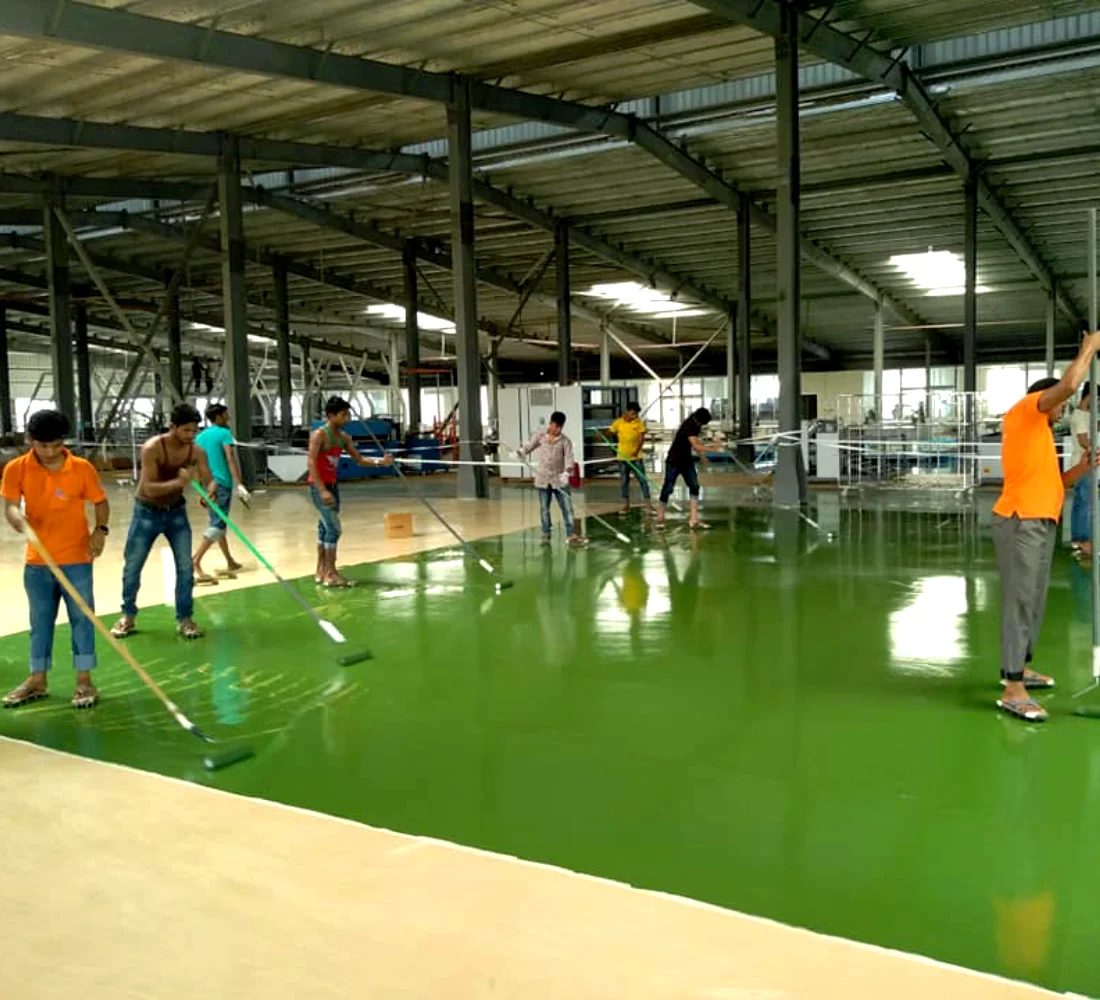
Industrial flooring cost in Bangladesh is one of the most misunderstood line items in a factory budget. Owners often collect three quotations, pick the lowest rate per square foot, and then spend twice that amount two years later redoing the same floor. The rate is not the cost. The system is.
This guide breaks down what industrial flooring actually costs in Bangladesh, what makes one quotation cheaper than another, which system suits which type of plant, and the mistakes that turn a cheap floor into an expensive one.
Quick answer
Industrial flooring in Bangladesh is priced per square foot, and the figure is driven by five things: system thickness, resin chemistry, the condition of your existing concrete, project size, and the detailing you need such as coving, drains and line marking. A basic floor hardener or dust-proofer sits at the bottom of the range, epoxy coatings and self-levelling epoxy screeds sit in the middle, and heavy-duty PU screed, conductive and ESD systems sit at the premium end. Because material and preparation dominate the cost, the honest way to get a number is a site survey and a written, layer-by-layer specification. Judge the result on cost per year of service, not on the headline rate.
What is industrial flooring?
Industrial flooring is an engineered surface system applied over a concrete slab to give it properties the concrete does not have on its own: abrasion resistance, chemical resistance, impact strength, cleanability, slip resistance and a dust-free finish. It is not paint. A proper industrial floor is a layered build consisting of mechanical surface preparation, a penetrating primer, a body coat or screed that carries the load, and a topcoat that takes the wear.
Bare concrete looks solid but it is porous and alkaline. It dusts under traffic, absorbs oil and chemicals, spalls at joints, and creates the fine airborne particles that ruin electronics assembly and fail food audits. An industrial floor system seals all of that and turns the slab into a working asset with a predictable service life.
In practice, industrial flooring in Bangladesh covers everything from a warehouse dust-proofer to a 9 mm polyurethane screed in a dairy plant. That spread is exactly why a single price never applies. You can see the full range of systems on our Industrial Flooring page.
Industrial flooring cost: how the systems compare
Rather than publishing fixed figures that go out of date with every shift in exchange rates and freight, it is more useful to understand the relative cost bands and what you get for the extra money. The list below runs from the most economical to the most expensive per square foot.
| System | Typical build | Relative cost | What you are buying |
|---|---|---|---|
| Floor hardener / dust-proofer | Surface treatment | Lowest | Reduced dusting and a harder wearing surface at minimum spend |
| Epoxy coating | 2 to 3 roller coats | Low | A sealed, cleanable, glossy floor for light to medium traffic |
| Polished concrete | Multi-stage grinding and densifying | Low to medium | Very long service life with no coating to peel |
| Self-levelling epoxy screed | 2 to 3 mm | Medium | Load-bearing thickness, seamless finish, forklift durability |
| Flake epoxy system | 1.5 to 3 mm | Medium | Hides wear and marks, adds texture and slip resistance |
| Super flat flooring | Laser-guided placement and grinding | Medium to high | Flatness tolerance for high-bay racking and VNA trucks |
| Heavy-duty PU screed | 4 to 9 mm | High | Thermal shock, wet processing and organic acid survival |
| Conductive / ESD flooring | 2 to 3 mm plus copper grid | High | Controlled electrical resistance with test certification |
One important comparison people miss: the cheapest option is rarely the cheapest over ten years. A dust-proofer may cost a fraction of a PU screed, but in a wash-down area it will need replacing repeatedly while the PU screed is still in service. Divide the installed cost by realistic years of service and the ranking often reverses.
Factors that affect industrial flooring cost in Bangladesh
System thickness
Material is the single largest component of any resin floor, and consumption rises almost in line with thickness. Moving from a 0.3 mm coating to a 3 mm screed is a tenfold jump in material. This is usually the real reason two quotations differ, even when both say epoxy.
Condition of the existing slab
Every industrial floor needs mechanical preparation, either diamond grinding or shot blasting, so the primer can key into the concrete. Beyond that, old slabs often need crack stitching, spall and pothole repair, removal of oil-contaminated layers, joint reconstruction, and correction of falls to drain. On a badly neglected slab this remedial work can rival the resin cost. It is also non-negotiable, because adhesion failure almost always traces back to preparation that was skipped.
Moisture in the substrate
Ground-floor slabs in Bangladesh frequently lack an effective damp-proof membrane. Rising moisture vapour builds pressure under a sealed film and lifts it in blisters. If a moisture test shows a problem, the specification needs a moisture-tolerant primer or a vapour-barrier build, and that adds cost. Discovering it after installation costs far more.
Resin chemistry
Standard epoxy, solvent-free epoxy, novolac epoxy for aggressive chemicals, polyurethane for temperature and UV, and conductive formulations all sit at different raw material prices. Systems from established manufacturers carry a premium over unbranded local blends, along with data sheets, batch traceability and a warranty that means something.
Project size and phasing
Mobilisation, grinding equipment, generators and crew transport are largely fixed costs. Spread over 50,000 sft they are minor; spread over 800 sft they dominate. Working nights, handing over zone by zone inside a running plant, protecting adjacent production areas, and material handling to upper floors all add hours and therefore cost.
Location
Sites in Dhaka, Gazipur and Narayanganj are straightforward. Chattogram, Cumilla, Bogura, Khulna and remote EPZ locations add transport and accommodation. Reliable three-phase power on site also matters, because grinders and planetary machines are power-hungry.
Detailing and extras
Integral coving at wall junctions, mechanically anchored drain terminations, expansion joint treatment, anti-skid ramp finishes, colour zoning, safety line marking and bay demarcation are separate line items in any honest quotation. In food, pharma and export-audited plants these details are what make the floor compliant rather than merely presentable.
Downtime
This is the cost that never appears in a quotation. Standard epoxy screeds need curing time before traffic returns. Fast-cure PU systems cost more per square foot but hand the area back sooner. If a stopped line costs you real money per day, the faster system can be the cheaper decision overall.
Types of industrial flooring available in Bangladesh
Epoxy coating
Two to three roller-applied coats over a primed slab. Economical, seamless, easy to clean, and suitable for storage areas, assembly halls, light workshops and general factory circulation.
Self-levelling epoxy screed
A 2 to 3 mm poured build that levels minor slab irregularities and carries genuine mechanical load. The workhorse specification for garment production, packaging, electronics and medium-duty warehousing.
Heavy-duty PU screed
Cementitious urethane at 4 to 9 mm. Tolerates hot wash-down, steam cleaning, sudden temperature change and organic acids. The default for dairy, beverage, poultry, fish, bakery, commercial kitchens and pharmaceutical wet areas.
Conductive and anti-static systems
Built with a conductive primer and copper earthing grid to hold resistance within a specified range. Required in electronics manufacturing, server rooms, explosive or flammable atmospheres, and certain pharmaceutical zones.
Polished concrete
Mechanical grinding and densifying of the slab itself. Nothing to delaminate, extremely long-lived, and well suited to large warehouses and showrooms where the concrete look is acceptable.
Floor hardener
Applied to reduce dusting and increase surface hardness. The right choice when the budget is tight and the only real requirement is a cleaner, tougher warehouse slab.
Super flat flooring
Laser-guided placement and precision grinding to meet flatness tolerances needed for high-bay racking and narrow-aisle trucks. Specified by the racking design, not by preference.
Decorative industrial systems
Flake, metallic and 3D epoxy finishes for factory showrooms, reception areas, canteens anddisplay spaces where appearance carries weight alongside durability.
Real-world applications
Garment and textile units. High foot traffic, trolley wheels, needle and lint dust. A self-levelling epoxy screed with clear bay demarcation keeps the floor cleanable and helps during buyer compliance audits.
Food and beverage plants. Constant water, hot cleaning cycles, fats and organic acids. PU screed with integral coving and correct falls to drain is the only system that reliably survives and passes inspection.
Pharmaceutical manufacturing. Cleanroom-grade seamless finishes, coved junctions, chemical resistance and in some zones controlled conductivity.
Warehouses and distribution centres. Point loads under racking legs, forklift wear at aisle ends. Polished concrete or epoxy screed, with super flat tolerances where high-bay racking is installed.
Cold stores and freezers. Sub-zero service and defrost cycles demand PU screed, applied under controlled conditions.
Engineering workshops and automotive. Oil, grease, solvents, dropped tools and steel wheels. Epoxy screed with a chemically resistant topcoat, plus anti-skid detail at wet bays.
Car parks and ramps. Tyre scuffing, point braking loads and sunlight exposure. A UV-stable PU deck coating on a car park flooring build, with textured ramps.
Common mistakes that increase the real cost
Buying on rate instead of specification. A quotation that says only industrial flooring at a certain rate per sft tells you nothing. Without product names, thickness and preparation method you cannot compare two bids at all.
Cutting the preparation. Acid etching or a quick sweep instead of grinding and shot blasting saves a little at the start and guarantees peeling later. Removing a delaminated floor costs more than installing it correctly did.
Ignoring the moisture test. Blistering from vapour pressure is the most common resin floor failure on ground-floor slabs in this country, and it is entirely preventable with a test and the right primer.
Specifying one system for the whole building. Dry storage, wet processing, electronics rooms and external ramps have different needs. Zoning the building almost always costs less overall than over-specifying everywhere or under-specifying somewhere critical.
Forgetting the details. No coving, no drain termination, no joint treatment. The field of the floor survives while the edges and drains fail, and edges are where failure spreads from.
Choosing gloss over grip. A mirror finish looks impressive at handover and becomes a liability in a wet or oily area. Slip resistance should be specified zone by zone.
Skipping maintenance. Wrong detergent pH, hosing without mechanical scrubbing, and leaving aggressive spills to sit will shorten the life of any system regardless of what you paid.
Hiring a painting contractor. Resin flooring needs calibrated mixing, controlled pot life, correct application temperature and trained crews. It is a construction chemical trade, not a painting job.
How to choose the right industrial flooring solution
Start by writing down the answers to seven questions about the space. What is the heaviest wheel or point load, and are the wheels steel or polyurethane? What is the maximum surface temperature and is there thermal cycling? Exactly which chemicals are spilled, at what concentration, and how fast are they cleaned? Is the area wet, occasionally washed, or dry? What slip resistance do you need when the floor is contaminated? How many hours of shutdown can you afford per zone? And what does a moisture test on the slab show?
Take those answers to a supplier and ask for a zone-wise specification stating, for each area, the manufacturer and product name of every layer, total thickness in millimetres, preparation method, expected consumption per square metre, curing and return-to-service schedule, detailing scope, and warranty terms. Then compare bids line by line rather than on the bottom figure.
Finally, ask to walk on a completed floor of similar duty that has been in service for several years. Nothing in a brochure carries the same weight as a five-year-old floor still doing its job in a working factory.
Frequently asked questions
How is industrial flooring priced in Bangladesh?
Almost always per square foot of finished floor, quoted against a defined system. The same area can carry very different rates depending on thickness, chemistry and how much repair the existing slab needs.
Why did I receive three quotations with completely different rates?
Usually because they are not the same floor. Check the specified thickness, the number of coats, the named products and the preparation method. A 0.3 mm coating and a 3 mm screed are both called epoxy and are not comparable.
Is PU flooring worth the extra cost over epoxy?
In wet processing, thermal cycling and food acid environments, yes, because epoxy fails early there. In dry mechanical environments epoxy usually delivers better value.
Can industrial flooring be installed without stopping production?
Generally yes, by phasing the work zone by zone, working nights or weekends, and using containment and dust extraction to protect running areas. Fast-cure systems shorten each handover window.
How long does an industrial floor last?
A correctly specified and properly installed system serves for many years. Service life is decided by substrate preparation, matching the chemistry to the actual exposure, and routine cleaning, far more than by age alone.
Do you provide industrial flooring outside Dhaka?
Yes. We operate countrywide, including Gazipur, Narayanganj, Chattogram, Cumilla, Bogura, Khulna and the export processing zones.
Can an existing damaged epoxy floor be repaired instead of replaced?
Often yes. If the failure is localised and the surrounding bond is sound, the affected area can be cut out, prepared and rebuilt. Widespread delamination or an untreated moisture problem calls for full removal and a corrected specification.
What warranty should I expect?
A written warranty covering adhesion and workmanship, tied to a stated specification and a defined maintenance regime. Be cautious of verbal assurances with no documented system behind them.
Conclusion
Industrial flooring cost in Bangladesh comes down to a simple principle: you pay for thickness, chemistry, preparation and detailing, and you save on all four only by accepting a shorter service life. The lowest rate per square foot is frequently the highest cost per year. Define the conditions in your plant honestly, insist on a written layer-by-layer specification, zone the building instead of applying one product everywhere, and never allow preparation to be trimmed to hit a number.
Elite Crete Bangladesh has been specifying and installing industrial floors since 2007, with more than a thousand completed projects, as authorised applicators and distributors for Elite Crete USA, BASF, DUCON, VIACOR and PIDILITE. We survey the slab, test for moisture, recommend the lightest system that will genuinely survive your conditions, and issue a line-item quotation you can audit.
Get a free site inspection and quotation
Send us your floor area, plant type and process conditions, and our technical team will visit the site, assess the substrate and give you a zone-wise specification with transparent pricing. No obligation, and no guesswork.
Book your free site inspection and get a detailed quotation
Call our hotline on +880 1888 818 499, or email info@elitecrete.com.bd.